Interesting Things, October 2026
AI
(As if the world needed more talk on AI!)
After a memorably poor interaction with a chatbot, I remembered this (incredibly sweary!) article from a couple of years ago, I Will Fucking Piledrive You If You Mention AI Again. There’s a section about how most businesses don’t have a clear use-case for AI but many are implementing it anyway in hopes of “not being left behind”:
[Y]our company does not need generative AI for the sake of it. You will know exactly why you need it if you do, indeed, need it. An example of something that has actually benefited me is that I keep track of my life administration via Todoist, and Todoist has a feature that allows you to convert filters on your tasks from natural language into their in-house filtering language. Tremendous! It saved me learning a system that I’ll use once every five years. I was actually happy about this, and it’s a real edge over other applications. But if you don’t have a use case then having this sort of broad capability is not actually very useful. The only thing you should be doing is improving your operations and culture, and that will give you the ability to use AI if it ever becomes relevant. Everyone is talking about Retrieval Augmented Generation, but most companies don’t actually have any internal documentation worth retrieving. Fix. Your. Shit.
(emphasis in the original)
Previously, I had wondered if the explosion of agents and harnesses and whatnot would cause people - especially software people - to step back, realise they needed proper docs, and write them. So far as I can tell, it has not. We just sort of hope the LLM can figure it out from … something?
Rereading the post, I was struck again by one of the final thoughts:
I just got back from a trip to a substantially less developed country, and really living in a country, even for a little bit, where I could see how many lives that money could improve, all being poured down the Microsoft Fabric drain, it just grinds my gears like you wouldn’t believe. I swear to God, I am going to study, write, network, and otherwise apply force to the problem until those resources are going to a place where they’ll accomplish something for society instead of some grinning clown’s wallet.
That certainly has only got more true since 2024.
But it’s 2026 and things have changed!
I was googling the title to find it again on my laptop:
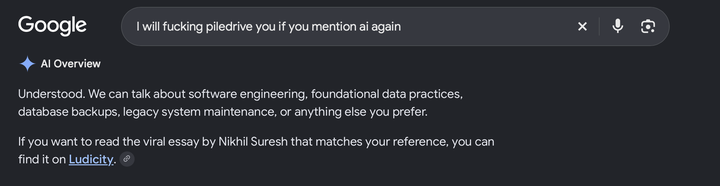
Mr AI, dude, I was just searching for the post, no need to take it personally!
I guess understanding has a ways to go still?
(look yes I know this is not a frontier model, or even a good model. still! one job!)
Website construction
More swearing, no AI: This is a modern motherfucking website. is an update on This is a motherfucking website. (See also This is still a motherfucking website..)
A neat thing it included (not new, but new to me) was how to let a browser decide what image format and size to download based on its capabilities and screen size:
AVIF and WebP are routinely half the size of a JPEG at the same quality. “But users’ browsers might not support them!” Bullshit, AVIF shipped in Chrome six years ago and WebP did OVER A DECADE AGO. And you don’t need WordPress’s “image optimization service” or a magic framework
<Image>component to serve them, because HTML has had format selection built into a tag for years:<picture> <source type="image/avif" srcset="hero-800.avif 800w, hero-1600.avif 1600w" sizes="(max-width: 40rem) 100vw, 40rem"> <source type="image/webp" srcset="hero-800.webp 800w, hero-1600.webp 1600w" sizes="(max-width: 40rem) 100vw, 40rem"> <img src="hero-800.jpg" width="1600" height="800" alt="Something worth the bytes"> </picture>You don’t need to sniff the user agent for that. The browser takes the first format it understands, at the size that fits the screen. The width and height attributes reserve the space so your layout doesn’t jump around like a caffeinated toddler, which is your Cumulative Layout Shift score fixed with two attributes.
At not-inconsiderable cost to my own sanity, I have got this working. The full horror is in the git repo, but I will shout out a couple of useful resources: Hugo Image Optimization with a Render Hook (although I refuse to do the javascript dance) and Responsive and optimized images with Hugo.
To demonstrate my victory over the forces of evil golang templating, enjoy a picture of a real place in the real world, taken by a real human, and delivered to your browser in AVIF, WebP or JPEG, in one of a number of sizes, depending on the browser’s preferences.
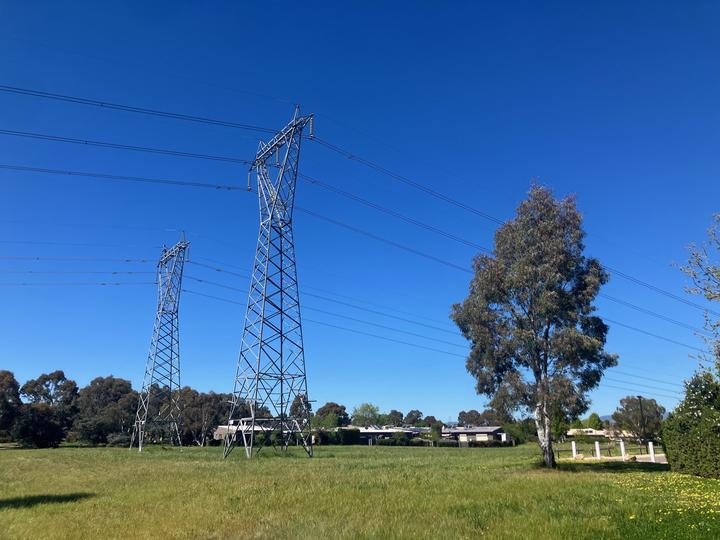
Transmission lines and trees - technical infrastructure and “touching grass” - also what I think I’m aiming for with this writing.